Toyota Yaris: Fuel and Engine Exhaust Precautions / Fuel Requirements
Vehicles with catalytic converters or oxygen sensors must use ONLY UNLEADED FUEL, which will reduce exhaust emissions and keep spark plug fouling to a minimum.
To achieve maximum engine performance, use the specified fuel.

* 1: U.S. federal law requires that octane ratings be posted on gas station pumps.
Fuel with a rating lower than 87 octane (91 RON) could cause the emission control system to lose effectiveness. It could also cause engine knocking and serious engine damage.
Gasoline blended with oxygenates such as alcohol or ether compounds are generally referred to as oxygenated fuels. The common gasoline blend that can be used with your vehicle is ethanol blended at no more than 10 %. Gasoline containing alcohol, such as ethanol or methanol, may be marketed under the name “Gasohol”.
Vehicle damage and drivability problems resulting from the use of the following may not be covered by the warranty.
- Gasohol containing more than 10 % ethanol.
- Gasoline or gasohol containing methanol.
- Leaded fuel or leaded gasohol.
NOTICE
- USE ONLY UNLEADED FUEL.
Leaded fuel is harmful to the catalytic converter and oxygen sensors and will lead to deterioration of the emission control system and or failures.
- This vehicle can only use oxygenated fuels containing no more than 10 % ethanol by volume. Damage to the vehicle may occur when ethanol exceeds this recommendation, or if the gasoline contains any methanol. Stop using gasohol of any kind if your vehicle engine is performing poorly.
- Never add fuel system additives other than a Toyota genuine product, otherwise the emission control system could be damaged. Consult your Toyota dealer for details.

 Emission Control System
This vehicle is equipped with an emission control system (the catalytic
converter is part of this system) that enables the vehicle to comply
with existing exhaust emissions requirements...
Other information:
Toyota Yaris XP210 (2020-2026) Owner's Manual: Operating Tips for AAC
AAC stands for Advanced Audio Coding, which is standardized voice compression established by the ISO* 1 working group (MPEG). Audio data can be created and stored at a higher compression ratio than MP3. This unit plays files with the extensions (...
Toyota Yaris XP210 (2020-2026) Reapir and Service Manual: How To Proceed With Troubleshooting
CAUTION / NOTICE / HINT HINT: Use these procedures to troubleshoot the CXPI communication system. *: Use the GTS. PROCEDURE 1. VEHICLE BROUGHT TO WORKSHOP NEXT 2. INSPECT AUXILIARY BATTERY VOLTAGE (a) Measure the auxiliary battery voltage with the ignition switch off...
Categories
- Manuals Home
- Toyota Yaris Owners Manual
- Toyota Yaris Service Manual
- Power Integration No.1 System Missing Message (B235287,B235587,B235787-B235987)
- Opening and Closing the Liftgate/Trunk Lid
- How to use USB mode
- New on site
- Most important about car
Refueling
Before refueling, close all the doors, windows, and the liftgate/trunk lid, and switch the ignition OFF.
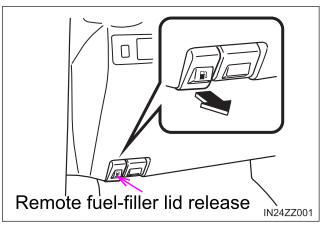
To open the fuel-filler lid, pull the remote fuel-filler lid release.